
Philosophy
We believe it is our duty to provide the animals entrusted to us with a species-centered approach to care.
Equines have three essential needs: friends, forage, and freedom.
As highly social prey animals, daily socialization with other equines is vital to a horse's well-being. We believe in keeping equines in a herd setting whenever possible so they have opportunities for mutual grooming, playing, and resting together. None of our equines are stalled except when treating an illness or injury. While in training, equines are housed in BLM-approved paddocks until they can be caught and haltered and then are turned out with the rest of the herd.
Equines are grazing animals and do best on a forage-based diet. Our equines are provided grass hay in slow feeders for their digestive and mental health. They also receive an age-appropriate ration balancer / vitamin and mineral supplement and free-choice access to salt and minerals. Horses with special dietary or caloric needs receive additional supplementation as required.
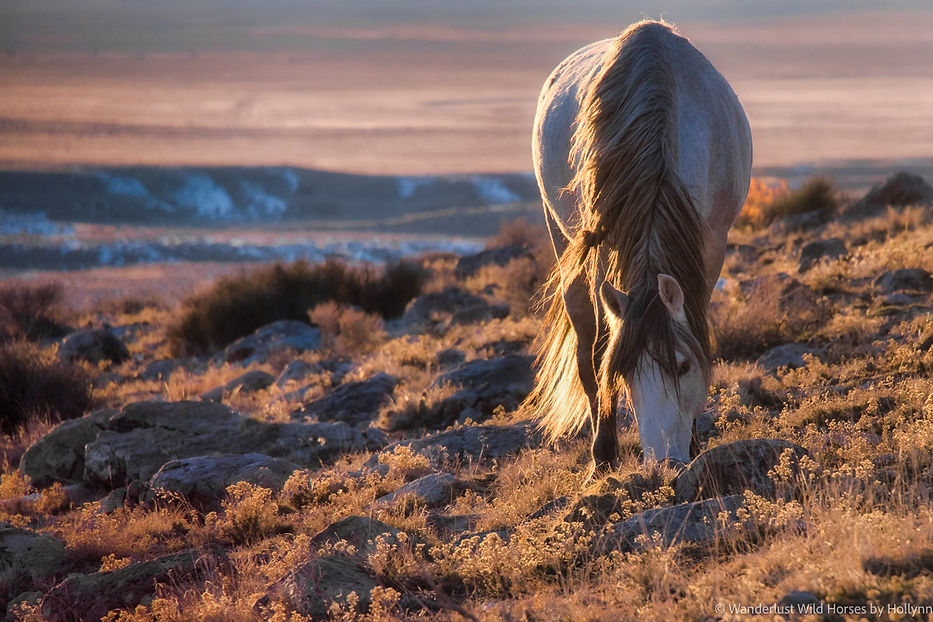
Freedom in this context refers to freedom of movement and freedom of choice. In their natural setting, equines travel 8-10 miles per day for shelter, food, and water. This movement over varied terrain helps keep them happy, healthy, and sound. Jaime Jackson studied the movement of the West Desert mustangs and then tried to duplicate that for confined equines in his "Paddock Paradise" system.
We are working with a rotational grazing specialist to design a track system for our horses with "interest points" for the horses such as a scratching station, a mineral lick, a sandpit for rolling, and a splash pond. This will be implemented in phases to account for the cost of fencing and infrastructure, but at its completion we plan to have over two miles of naturally surfaced terrain connecting rotational grazing pastures seeded with native Western range grasses.
Training Methods
We have always believed in utilizing the most gentle, equine-centered approach to training possible.
We believe in a "partnership" model, where a trainer requests a horse to do something rather than forcing the horse to comply.
Our training started out using variations on some Natural Horsemanship techniques and methods, but as our understanding of horse behavior has evolved, so have our training methods.
We use a variety of training methods, most closely aligned with force-free or partnership training and positive reinforcement techniques, centered on a set of principles that prioritize safety of the equine and handler, and active participation in two-way communication between equine and trainer.
As we expand into our new facilities, we hope to host training seminars, clinics and camps to promote the equine-centered approach to training and further engage the community in this mission.